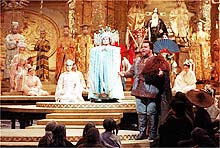
| Taking On 'Turandot' Under Scrutiny Metropolitan Opera: "Turandot" ANTHONY TOMMASINI 10/02/00 The American dramatic soprano Alessandra Marc has an ardent contingent of fans who believe that she has not received her due from the critics and the public. So there was much anticipation before her performance on Saturday afternoon at the Metropolitan Opera in the title role of Puccini's "Turandot," its first presentation this season. Ms. Marc, who made her Met debut as Verdi's Aida in 1989, had been scheduled to sing Turandot later this month. But because of the illness of Sharon Sweet, who was to have sung the role on Saturday, Ms. Marc's return to the Met came earlier than expected.
Ms. Marc is a dramatic soprano of consequence. Still, to the unconverted she seems a curiously uneven singer with a huge but wild voice. She works mightily to control that voice, which is unsettling, though exciting. As you listen, you wonder what will happen next. Turandot, an icy princess in ancient Peking, has the most blazing entrance aria in all of opera, "In questa reggia," coming halfway through Act II. The princess has turned an obsessive hatred of men into a chance game of life and death. Any suitor who desires her must answer Turandot's riddles or pay with his life. Ms. Marc sang the aria with noticeable caution and a somewhat muffled sound. She scooped up to high notes and was careless about rhythm. But as the scene progressed and her voice warmed up she displayed burnished tone and enormous volume, especially in the climactic phrases that soar above the orchestra and chorus. There can be a strident, wobbly quality to her sound, and her pitch sometimes veers off. Yet there is no denying the sheer impact of her voice. Like other sopranos currently singing this role, including Jane Eaglen, who will perform it at the Met later this month, Ms. Marc is a large woman who does not move easily. It was nerve-racking to watch her in Turandot's cumbersome, bejeweled robes and headdress as she haltingly navigated the network of stairs and platforms of Franco Zeffirelli's 1987 production, a critic-proof extravaganza that Met audiences adore. The tenor Richard Margison sang Calaf, the exiled prince who wins Turandot's riddle game and her love. Though a stiff actor, Mr. Margison has one of the most appealing tenor voices around. Without any force, he filled phrases with warm, radiant sound. The day's largest ovations went to the Chilean soprano Cristina Gallardo-Domas as the slave Liu, who has tended to Calaf's blind and helpless exiled father, Timur. Though she does not have the most conventionally beautiful voice, she is an excellent singer and dramatically involving artist who floated tender, soft high notes in "Signore, ascolta" and brought affecting intensity to Liu's poignant death scene. The always dependable bass Paul Plishka was a resonant-voiced and pitiable Timur. Marco Armiliato, the usually strong conductor, was perhaps trying too hard to bring freshness to this familiar score. Tempos shifted precipitously, and the big, brassy Puccini chords, spiked with dissonance, that punctuate the score were not always balanced effectively. Still, the opera swept along and swept the audience with it, as it usually does. |