
ニューヨーク・タイムス・オペラ・レビュー
「ボエーム」 メトロポリタン歌劇場 ジェームス・R・オーストリッチ (石綿さん訳)
もうたくさん、ゼフェレッリのオペラ!
メトロポリタン歌劇場にはテープレコーダーを歌劇場内に持ち込んで(もちろんオフステージで)、のちのち名演との評価を受けそうな
上演をこっそりと録音するという特有の犯罪がある。あるものはそのコピーを横流しして不正な利益を得ている。
先週の金曜の夜、今シーズンメットでの最初のプッチーニの「ボエーム」が上演されたが、そのときの一番、目だった不法持込物は
フラッシュ付カメラであった。それは、まさに1981年以来のフランコ・ゼフェレッリ演出そのもの(の話題性)を示すものであり、
何度も、いろいろな形で言われてきたことである。
この誇大妄想的なしろものは、あのラスプーチン以上と思われる致命的な攻撃を受けてきたが、それでも毎年懲りずにしゃあしゃあと
現れるのを見せられて批評家に無力感を感じさせるのは、もうたくさんである。今回の上演では間違いなく空席が目立っていたが、それでも来シーズンまたこのゼフェレッリのリバイバル公演が既に発表されている。
第1幕と第4幕で出てくる広大なパリの屋根の連なる風景−−聴衆にとって幸いなことに、我らがボヘミアンたちは、たまたま、
なかでももっとも高い位置の屋根裏部屋を占めているが−−今や多少なりとも当たり前のことと取られるようになっている。パリの雰囲気を出した第2幕のラテン街の場面だけでなく第3幕の雪の場面に対しても、いつも結構な喝采が送られている。この金曜日の公演では
本物の馬が馬車を引いて舞台に登場したが、それすら大いに受けていた。
しかし、こんな行き過ぎた安っぽさはコストがかかるだけでなく気持ちをしらけさせるものだ。
メットやそのスポンサーたちが、どう彼らの金を使おうと、彼らの勝手ではあるが、このような演出に費やしたお金は、芸術的に
どんなメリットがあろうと、長期にわたる償却が必要である。 しかも、このボエームの場合、芸術的なメリットを見出すのは、しばしば
困難である。こんな贅沢な演出をバックにしては、パバロッティぐらいの声量と巨体がなければ、たとえどんな歌手であろうと名唱どころか印象に残る歌唱すら困難である。
音楽的にもメットならではのコーラスとオーケストラの星をちりばめたような華麗な演奏以外はとりたてて注目すべきものはなかった。
マルコ・アルミリアートはオーケストラにヴィルチュオーソらしき離れ業を演じさせたと思えば歌手にはのびのびと自由な歌唱をうながし、
どちらにも花を持たせる指揮振りであった。
ローマ生まれのソプラノ、レオンティナ・バドゥーバはEMIにミミを歌ってレコーディングもしているが、この日は気持ち良く歌ったものの、
メットデビューとしては残念ながら印象は薄い。彼女の声は最高音がやや苦しい。
ロドルフォはおなじみとなったルイス・リマであるが大成功とは言い難い出来であった。穏やかな歌い振りは、終始問題があった。
出だしはやや粗削り、その後不安定で、しかもポルタメント多用による声のずり上げは重苦しさを感じさせる。
メットでミミを歌ったこともあるアイノア・アルテータのムゼッタは高音の美しさと舞台栄えのする容姿で出演歌手の中で最高の出来で
あった。マルチェロを歌ったサイモン・キーンリサイドは男声陣の中では最も良かった。もっともあまり重要でない役のコリーネのエギリス・シリンズ、ジュナールのメル・ウルリッヒ、ベノワとアルチンドロを歌ったトーマス・ハモンズらはすべて役としては十分の出来栄えといえたが。
次回の公演は明日だが、まだ席はたっぷり空いていそうだ。
`Boheme,' You Know, Back Again, Via Zeffirelli
"La Boheme" at the Metropolitan
Opera
JAMES R. OESTREICH
03/28/00
The crime of choice at the Metropolitan Opera --- offstage, at least --- used to be sneaking a tape recorder into the house to preserve the memory of a potentially thrilling performance. Some perpetrators compounded the misdemeanor by running off copies to turn an illicit profit.
|
|
|
|
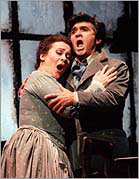
| Leontina Vaduva as Mimi and Luis Lima as Rodolfo. (Sara Krulwich/The New York Times) | |
|
On Friday evening, at the Met's first performance of Puccini's "Boheme" this season, the illegal weapon most in evidence was the flash camera. That pretty much says it all about Franco Zeffirelli's production, from 1981, and it has been said many times, many ways.
Indeed, it is enough (almost) to keep a critic humble, seeing this bloated extravaganza, which has absorbed more seemingly lethal blows than Rasputin, blithely surface year after year. There were many empty seats this time round, to be sure, but another revival has already been announced for next season.
The vast Parisian roofscape of Acts I and IV, in which--- fortunately for viewers and listeners--- our bohemians happen to occupy the highest garret, is by now taken more or less for granted. But delighted applause invariably greets not only the Latin Quarter of Act II, with all Paris, seemingly, out and about, but also the evocative snows of Act III. On Friday, even a horse was applauded for walking across the stage pulling a carriage. As cheap thrills go, both expensive and insipid.
How the Met and its patrons spend their money, of course, is their business. But the very expense of productions like this necessitates a long period of amortization, whatever the artistic merits.
And in this case those merits are often hard to find. Against such a lavish backdrop, it is difficult for any singer of less than Pavarottian amplitude in both voice and physique even to register, let alone make, a vivid impression.
Certainly, there was not much of great musical moment going on here except for the typically stellar work of the Met chorus and orchestra. Marco Armiliato was a mercurial conductor, by turns driving the orchestra to virtuosic flights and allowing the singers a relaxed expansiveness, with rewards both ways.
Leontina Vaduva, a Romanian soprano who has recorded the role of Mimi for EMI, sang it pleasantly though hardly compellingly in her Met debut. Her tone tended to constrict on her highest notes.
Luis Lima, a familiar presence, returned to the role of Rodolfo with limited success. His quiet singing was problematic throughout, grainy at the start, unreliable later on, and he tended to ascend through a portamento that evoked heavy lifting.
Ainhoa Arteta, who has also sung Mimi at the Met, gave the strongest performance, as Musetta, with clear tone into the heights and a striking stage presence. Simon Keenlyside, as Marcello, was the best of the men, though lesser roles were also filled well by Egils Silins (Colline), Mel Ulrich (Schaunard) and Thomas Hammons (Benoit and Alcindoro).
The next performance is tomorrow evening. There may well be seats available.
メット・オペラ・レビューのぺーじに戻る