Metropolitan Opera: "Carmen"
PAUL GRIFFITHS
10/25/00
There are times when the rest of "Carmen" seems like just a way of getting to the great scene in the fourth act when everything else has been cleared away − the minor characters, the chorus and, in Franco Zeffirelli's staging at the Met, the flamenco dancers, the donkeys, the priest and servers, the horses and the dogs − to leave just Carmen and Don Jose onstage, alone and together. So it was on Monday night, when the Met revived Mr. Zeffirelli's production for the first of only five performances with Olga Borodina in the title role and Roberto Alagna as her lover, her victim and her nemesis.
 |
|
|
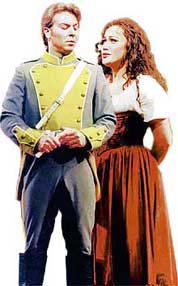 |
| Roberto Alagna and Olga Borodina in "Carmen" at the Metropolitan Opera. (Sara Krulwich/The New York Times) | |
|
|
But in the last act she exceeded anything she had attempted up to that point. The crucial line - the line that is one of the most desperate in all opera: "No, I don't love you anymore" - she sang as if certain of it, unflinchingly truthful, and yet at the same time surprised and even a little appalled by the message she was conveying. There was coldness in her voice, but also sensitivity. It was as if she realized, in this moment, the different kind of love that Don Jose had felt: not playful, wild and sudden, but sure and for the long term. She knew now that the catastrophe was bound to happen, that she was going to die.
Mr. Alagna in this final scene was a man playing every card in his hand, vocal and dramatic, and winning with each one of them. His singing was consistently strong, impassioned right to the edge - but not beyond - of what good tone can support, and hugely versatile in expressive weight and coloring. There was crazed hope here, violence, spited love, sweetness, all turning into weapons, one of which was certain to end up thrust into Carmen's side.
These two were, in every essence, the opera. But Rene Pape's Escamillo was also a striking achievement. He used his height, his agility and his roguish grin to excellent effect, but he also used his strong, steady, blackish and seductive voice to create the image of rampant maleness in a suit of lights.
Norah Amsellem, as Micaela, sounded a confident note of goodness in her brightly sung prayer in the second act. Others in the cast included Emily Pulley as Frasquita and Jossie Perez as Mercedes, the latter showing a sultriness that was beautiful, yet precise, in her house debut.
The conductor, Bertrand de Billy, often went for speed and squareness: the opening sounded like the "Carmen" march Sousa never wrote. But in that intense last scene he and the orchestra were vividly in support.