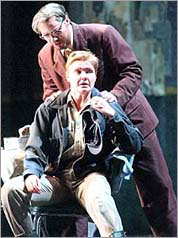
| A Polemic Ripped From Today's Headlines "Fidelio" at the Metropolitan Opera BERNARD HOLLAND 10/16/00 Current events play into the hands of the Metropolitan Opera's new production of "Fidelio." Gone is the tatty eyesore that limped regularly on and off the Met's stage. In its place, Jurgen Flimm's grim update of prison walls, cellblocks and civil unrest: stage pictures that would fit credibly on the screens of television news.
The creator of last summer's "Ring" at the Bayreuth Festival is once again a practical man of the theater, not a maker of manifestoes. Scenes are made to look familiar to us right now; the need for suspensions of disbelief is at a minimum. Besotted by the American and French Revolutions and their noble possibilities, Beethoven made "Fidelio" a manifesto in itself, giving his opera an earnestness and passion that almost smothers it in good will. Here is great music driven by heartfelt sentiment, struggling to occupy an operatic stage. The paradox is in ensembles and set pieces that are musical masterpieces and acute studies of human nature awkwardly aligned to the flow of events on the stage. Great moments either bump into each other or sit uncomfortably apart. In Act II a powerful tenor aria rushes past a narrative void and collides with a choral finale that comes as close to mass hysteria as a great composer will allow. There is not enough space to recover from the first and prepare for the second. The domestic scenes of Act I, including a quartet and trio of extraordinary beauty and intimacy, never join fluently with the martial hubbub around them. Obsessive, half-mad, like a collection of small architectural masterpieces set in a chaotic city plan, "Fidelio" lurches magnificently. Mr. Flimm is attentive to human interchanges and competent in the maneuvering of crowds. Most elements of Beethoven's world have been credibly brought up to date. His production also, and I think unwisely, buys into the composer's excesses, namely a childlike highmindedness pretty much at odds with the more cynical world in which the Met finds itself. Beethoven's final roar of triumph and thanksgiving is frenzy without shame, and I wish Mr. Flimm had not so underlined its wild-eyed innocence with kneeling principals and semaphoric arm gestures. He is fortunate in his cast. Karita Mattila is a Leonora of astonishing force and concentration, qualities achieved at no loss of vocal beauty. As Florestan, Ben Heppner brings considerable grace to one of opera's most trying tenor roles. Ren Pape (Rocco) and Jennifer Welch-Babidge (Marzelline) were both elegance itself. Falk Struckmann's Pizarro forced and blustered in a way not all that inappropriate to the part. James Levine, known as a lover of orchestral beauty, met the sheer toughness of Beethoven's writing head on. The Met chorus, pushed to its limit, responded gloriously. Few of us are sorry to see the Met's old "Fidelio" go. Shabby and dated both in outlook and physical condition, it gave this problem opera little chance to overcome its problems. Is Mr. Flimm's new version a burst of excitement? No. But like his Wagner at Bayreuth last summer it makes sense to our eyes and ears and lets Beethoven's tortured dramaturgy do the best it can. Mr. Flimm also has Ms. Mattila, whose "Abscheulicher! wo eilst du hin" near the end of Act I was enough to send even the Met's staid audience rushing toward the barricades. |
|||||||