
「オランダ人の恐怖の物語に神話的、現代的側面」
メトロポリタン歌劇場「さまよえるオランダ人」
アンソニー・トマシーニ(石綿さん訳)
1989年のメトロポリタン歌劇場の「さまよえるオランダ人」大公演はバスのジェームス・モリスのために
上演されたものである。その時の彼のタイトル役演技はその偉大な経歴の中でも最高のできばえの一つといえた。
その公演がこの金曜日の夜、戻ってきた。オランダ人は同じモリス。神をのろった罪で永久に海をさまよう宣告を
受けたオランダ人の船長役である。7年に一度だけ港に停泊し、真実の愛で彼を救う女性を探すことが許される。
今回の公演は1993年から94年のシーズン以来だが、あの時の公演が持っていた何かに欠けているようだし、
モリスの声も風雨にさらされすぎたのか、このところやや生彩がない。それでもこの物語のぞっとさせるような
雰囲気は十分であった。指揮のワレリー・ゲルギエフはメットでワーグナーを振るのは初めてであるが、
その骨太の楽曲解釈は衆目の注目を浴びた。
昨年なくなったオーガスト・エバーディングの演出とハンス・シャヴァーノッホの舞台づくりはオペラというものは
むきだしで現代的なイメージ仕立てであっても物語の雰囲気をかもし出せるものだということを改めて感じさせる。
幕が上がると激しかった嵐を思わせる霧の間から氷が張り付いたダーラントの船が見える。ノルウェーの船長である
ダーラントは彼の住む町からほんの数マイル離れたところで嵐を避けるために船を避難させる場所を捜していたのだ。
険しく雪に覆われた崖が船に覆い被さるように不気味に迫っている。いつもながらのオペラの舞台を鑑賞できたはずだ。
不気味な光が船のデッキの上を照らす。光が薄れると共に音楽は次第に盛り上がっていく。そしてどこからともなく
オランダ人の幽霊船のような船が現れる。船腹は鋼鉄、幾何学的な形の奇妙な船。あかみがかったオレンジ色の錨が
ぶらさがり、恐ろしく巨大なタンカーのように見える。タラップが上からおろされるが舞台の床まではとどかない。
その危険な階段をオランダ人が重々しく降りてくる。十分に神話的であり現代的な場面だ。
その後、第2幕のはじめはダーラントが住んでいる町。女たちが一緒に座って糸を紡ぎながら、うっとりさせるような
ワーグナーの名曲「糸つむぎの合唱」を歌う。緊迫する場面の間でほっとするようなあたたかみのある場面。
ところがこの演出では工場のような狭苦しい場所、凍りついた窓、低く垂れ下がった味気ない灯りの下で女たちが
働いている。ミシンを使って海の男たちのために帆をつくろっているのだ。
この演出にはそのような気になるシーンが多い。つまりギル・ヴェクスラーの照明はこの初演では必ずしも適切
ではなかったということだ。 前回最後の公演では、第1幕と第3幕で使われていた不透明な背景の幕はそれほど
陰気でもなく目立ちもしなかった。
ワーグナーはこのオランダ人を演じる歌手については「恐いぐらいの平静さ」をもって感情を表現すべきである
と書いている。モリスは一挙一動これを身体で表現している。背が高く肩が張っているが、呪いのために消耗し
猫背となった姿は不恰好で哀れを催す。来年モリスはメットデビュー30周年の記念の年を迎える。その声も衰えが
見え始めた。とくに中低音はムラが目立つ。しかし不思議なことに高音のクライマックスの箇所では永年の疲れも
消えうせ、あの高名な力強いバスの声が劇場いっぱいによみがえる。 そうした声楽上の欠陥にかかわらず、
モリスは依然芸術的に高い境地にあり、深く劇的な表現力と知性を曲のすみずみまでに感じさせた。
ダーラントの娘ゼンタ役でメットにデビューしたのはスウェーデンのソプラノ、ニーナ・ステンメ。
その愛によってオランダ人の罪を償える女性になることを切望する役柄である。ステンメは立ち上がりに
やや時間がかかったが、その後は落ち着いた輝かしい声、時折は突き刺すような鋭い声で歌った。
幾分不安定な箇所もあったが、それは多分、少し無理をして本来の声量以上の声を出していたからであろう。
だがなんといっても美人だし、魅力的な演技と歌声の持ち主だ。 聴衆からも大喝采を受けていた。
少し頭の弱いゼンタの求婚者役、エリックでメットデビューしたのはドイツのテノール、ローランド・ワーゲンフォイラー。
舞台栄えしない役なので確かに目立つのは難しいが、それにしても印象は薄い。太く力強い調子で歌ってはいるが、
声自体は細い。魔笛のタミーノを歌うテノールがワーグナーを歌っているようなものになっている。今月後半、
フィデリオのフロレスタン役で2回出演することになっているので、そこで本来の力量を示すことが出来るだろう。
ジャン・ヘンドリック・ローテリングは侮りがたいバスだ。力強い声でいかにもお人好しという感じのダーラントを
演じた。舵取りを歌った若いテノール、マチュー・ポレンザーニは元気いっぱいで好感が持てる。いいテノールだ。
メゾソプラノのジル・グロウブは車椅子に乗りながらもつむぎ女たちを取り仕切るマリー役として好演。
指揮のゲルギエフはメットの伝統に従い、このオペラを3幕休みなしに演奏するというオリジナル版で演奏した。
ジェームス・レバインはメットのオーケストラと永年協力的な関係を保ってすばらしい業績を成し遂げてきたが、
ゲルギエフはいきなり入ってきて物事を刷新するのが好きなタイプのようだ。レバインほど技量的なうまさはないが、
その違いを逆手にとってオーケストラに絶えず緊張感をもたせている。 演奏は手堅いとはいえないが、
エキサイティングで霊感に富む。ゲルギエフは、物議をかもしたエピソードのことだけでなく、優雅でイタリア風の
音楽が流れているこのワーグナーの初期の作品を美しく仕上げた手腕でも強い印象を残してくれた。
Chilling Tale of Dutchman Has a Mythic, Modern
Edge
Metropolitan Opera: "Der Fliegende Hollander"
ANTHONY TOMMASINI
11/27/00
The Metropolitan Opera's powerful 1989 production of Wagner's "Fliegende Hollander" was mounted for the bass James Morris, whose portrayal of the title role was one of the finest achievements of his great career. The production returned to the Met on Friday night with Mr. Morris again as the Flying Dutchman, the cursed sea captain condemned to roam the ocean forever, allowed only once every seven years to dock his vessel and search for a woman whose true love can release him.
|
|
|
|
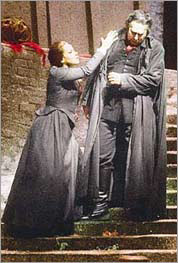
| Nina Stemme and James Morris in "Der Fliegende Hollander" at the Met. (Sara Krulwich/The New York Times) | |
|
|
Though the production lacked some of the focus it had when last at the Met during the 1993-94 season, and though Mr. Morris's voice is sounding weather-beaten these days, this was still a chilling evening of musical drama. The conductor Valery Gergiev, conducting his first Wagner opera at the Met, made news with his bracing account of the score.
The production, by August Everding, who died last year, with sets by Hans Schavernoch, shows that an opera can be staged with stark, contemporary imagery yet evoke the setting of the story. When the curtain goes up, through the misty aftermath of a violent storm we see the ice-encrusted ship of Daland, a Norwegian sea captain who has sought temporary refuge in a coastal haven just miles from the town where he lives. Looming over the ship are steep, snow-covered cliffs. We could be watching a traditional staging of the opera.
Then eerie searchlights from above scan the deck of the ship. The lights dim, the music swells, and out of nowhere the dreadful hulk of the Dutchman's vessel appears. With its steel sides, oddly geometric shape and dangling reddish-orange anchor, the ship looks like some terrifyingly huge oil tanker. A gangplank lowers from above yet doesn't quite touch the stage floor. And down this dangerously suspended staircase the Dutchman heavily treads. It's a powerfully mythic and modern image.
Later, in Act II, in Daland's coastal hometown, women sit together spinning as they sing Wagner's beguiling "Spinning Chorus." Typically, it's a genial, welcome break from the tension. In this production the woman labor in a constricted space that looks like a factory, with low-hung industrial lights and windows frosted with ice. Operating sewing machines, they repair enormous swaths of sails for the seamen.
The production is filled with such unforgettable images. That said, the lighting by Gil Wechsler was perhaps not quite right for this first performance. The last time out, the cloudy scrims that are used in Acts I and III did not seem so murky and noticeable.
Wagner wrote that the singer portraying the Dutchman should convey emotion through a "terrible repose." Mr. Morris embodies this quality in every glance and step. Tall, square-shouldered and bent over with the exhaustion of his curse, he is a hulking and pitiable figure. Next year Mr. Morris will celebrate the 30th anniversary of his Met debut, and his voice is showing signs of wear, especially in his patchy mid-range. Interestingly, in high-lying climactic phrases the years vanish and that famously powerful bass voice once again resounds in the hall. For all the vocal shortcomings, Mr. Morris is still at an artistic high point and brings deep dramatic insight and musical intelligence to every phrase.
Nina Stemme, a Swedish soprano, made her Met debut as Daland's daughter, Senta, who yearns to be the woman whose love can redeem the Dutchman. Though Ms. Stemme took some time to warm up, once she had, she sang with a cool, radiant and often penetrating sound. Some edgy tones suggested that perhaps Ms. Stemme was forcing her voice beyond its resources. But she is a lovely and compelling actress and an engaging singer. The audience gave her a rousing ovation.
Roland Wagenfuhrer, a German tenor, also made his Met debut as Erik, Senta's goofy young suitor. It is hard to stand out in this unrewarding role, and indeed, Mr. Wagenfuhrer made little impression. His tone is husky, but his voice is not. Here was Mozart's Tamino trying to be a Wagner tenor. Mr. Wagenfuhrer will have a better chance to show what he is capable of later this month when he sings two performances as Florestan in "Fidelio."
The formidable bass Jan-Hendrik Rootering was a vocally strong and believably well-meaning Daland. The fine young tenor Matthew Polenzani was an appropriately exuberant Steersman. The mezzo-soprano Jill Grove was sympathetic as a wheelchair-bound Mary, who supervises the spinning women.
Following the Met's practice, Mr. Gergiev conducted the original version of the opera, in which the three acts flow together without break. While James Levine has accomplished great things with the Met Orchestra by working in a collegial manner over long periods, Mr. Gergiev is the type of conductor who likes to come in and shake things up. Though not as technically adroit as Mr. Levine, he turns that difference to a kind of advantage, keeping the orchestra nervously alert. The playing was not the most solid, but it was continually exciting and often inspired. Mr. Gergiev impressed not just in the tumultuous episodes but also in his elegant shaping of the gracefully Italianate music that runs through this early Wagner work.