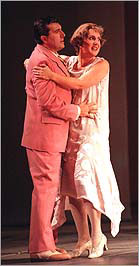
| Music Catering To the Words Of Fitzgerald BERNARD HOLLAND 12/22/99 One came away from "The Great Gatsby" at the Metropolitan Opera on Monday night thinking not so much about Daisy Buchanan, Nick Carraway or even Gatsby himself, but of what a nice man John Harbison must be. His new opera has many responsibilities to serve and much to live up to, and Mr. Harbison's sense of duty is palpable. Think of the obligations incurred: a handsome commission from the Met; a gilt-edged cast; an elegant staging by Mark Lamos, Michael Yeargan and Jane Greenwood; the ministrations of one of the world's great opera conductors, James Levine; voluminous pre-premiere publicity; and finally an F. Scott Fitzgerald novel of iconic stature.
In 3 hours and 15 minutes this composer serves his several masters with all the imagination at his disposal. When original dramatic effects are required, Mr. Harbison is there with his thudding percussive strokes. When scenes cry out for music of the Jazz Age, combos and megaphoned pop singers materialize onstage performing convincing syntheses of 1920's popular style. Everywhere is the spirit of accommodation. Every need is tended to, promptly and caringly. Powerful opera, on the other hand, may be more than doing the right thing. I have long gone along with the idea that success in this field means the judicious blend of music and words. "The Great Gatsby" makes me wonder. Powerful opera may well start with the monstrous musical ego: cruel to literature and contemptuous of everything around it. A friend suggested to me that opera ought not to be allowed near great writing, which "Gatsby" certainly is. I would alter that to say that opera should not be allowed to treat great writing with too much respect. For minutes at a stretch Mr. Harbison's music patiently accompanies operatic narrative and conversation that an Alban Berg would have squeezed mercilessly into seconds. One inches along these dreary passages waiting for the bursts of interest that occasionally appear. The composer tries to fill up long stretches with interesting music, but legato singing lines played against a busy movement in the orchestra results too often in mutual nullification. I wish there were more rhythmic and metric life in Mr. Harbison's music, but the tamely uniform sequential patterns simply do not rouse the ear. To compare Mr. Harbison's music with Verdi's would be manifestly unfair, but manner and approach are another matter. Verdi's love of Shakespeare did not prevent him from pouring acid over the skin and viscera of magnificent prose-poetry and writing operas using only the skeletal remains. Mr. Harbison's own libretto (with song lyrics by Murray Horwitz) extrudes and compresses, but it may be too respectful of Fitzgerald for its own good. "The Great Gatsby" is in 2 acts and 10 scenes, the latter bridged by orchestral interludes. Mr. Harbison ends with Gatsby's funeral, omitting Nick Carraway's final encounter with the Buchanans. This is sound theater in the big-finale tradition, although Fitzgerald's final sigh of despair might have been an updated, domesticated version of Mussorgsky's Idiot at the end of "Boris Godunov." The Long Island decor, backed by sheer, silken curtains, is elegance itself, and Ms. Greenaway's costumes, both men's and women's, are a constant delight. The opera catches fire twice, both times in the party scenes. Here music and dance do what they should be doing, overwhelming everything around them. Robert La Fosse's choreography glitters with frenetic energy and great charm. The cast is splendid. Dawn Upshaw and Susan Graham are Daisy and Jordan and could scarcely be better. Dwayne Croft's baritone as Nick is in luxurious condition, and Mark Baker is a forceful Tom Buchanan. Jerry Hadley takes the title role. His slightly overworked top register is probably an acquired taste (though one not in my possession). The Wilsons ? Lorraine Hunt Lieberson and Richard Paul Fink ? provide the needed rough edges. Somewhere in "The Great Gatsby," partly buried, lies an effective opera. Mr. Harbison is beholden to perhaps too many elements of this enterprise, but every so often his musical imagination rises, hearteningly, in revolt. His opera may also be the victim of the inflated expectations surrounding it. With a little less star treatment, "The Great Gatsby" might have passed quietly and benignly into our lives. |