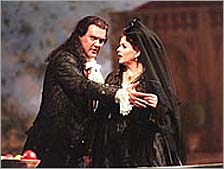
| Bryn Terfel, as Don Giovanni, Opens Met Opera
Season BERNARD HOLLAND 09/26/00 Opera has known its fleeting fames and forgotten masterpieces, but "Don Giovanni" is not among them. Since its debut at the Prague National Opera in 1787, Mozart's great work, subtitled "The Libertine Punished," has never been out of the international repertory. Presented with a difficult piece fueled by intricate ensembles and a swiftly moving libretto by Lorenzo da Ponte, companies large and small have had their go at it. In the "large" category is the Metropolitan Opera, which opened its season with "Don Giovanni" last night.
Opening night at the Met is not for the fashion-conscious faint of heart. Neither, however, is Franco Zeffirelli's ponderous production, which though less flamboyant than his usual work, still delights in dwarfing humankind under soaring pillars and furiously decorative detail. Indeed, last night's event promised one of two metaphors: one a mirror (opulence onstage seeing its reflection in the audience out front), the other a competition (with over- the-top contingents battling from either side of the footlights). Certainly Bergdorf Goodman is busy restocking this morning, but this "Don Giovanni" became much more than just another opening night. The first thing to wriggle free from these attention-grabbing surroundings was the exceptional cast. Rene Fleming sang Donna Anna; Bryn Terfel, known as much for his exquisite diction as for his stage presence, played the Don. Most Mozartian baritones long for the chance to do both major men's parts in "Don Giovanni," each blessed with marvelous music attached to very different personalities. Ferruccio Furlanetto, the evening's Leporello, has made a minicareer of alternating the two parts. Mr. Terfel makes the switch from Leporello this season.
A newcomer, the Norwegian soprano Solveig Kringelborn, sang Donna Elvira with a clean intensity. Hei-Kyung Hong was a Zerlina of jewel-like precision. Paul Groves was the dignified and affecting if modest-sounding Don Ottavio. James Levine conducted with passion and customary elegance. Also elevating the evening above the level of spectacle was Stephen Lawless's spruced-up restaging: a reworking terribly effective not for any coups or startling effects but for the care and intelligence of its detail. This was the kind of true theater that opera in general, especially in a nightly repertory house, does not often approach. There was purpose in every gesture. In keeping with the old laws of physics, for every action, there was a plausible reaction. Mr. Terfel comes to the Don with his own powerful if somewhat repugnant point of view. If the production is about period elegance, the character itself achieves a modern mean- spiritedness. Endearing naughtiness is replaced with outright sadism. This is a coldly obsessive figure for whom rape and murder is not offhand but committed with pleasure. On the other hand, this not very nice man sings like an angel. The articulation was wonderful, and Mr. Terfel commands such a depth of color that his "L・ci darem la mano" could soar out into the hall even at half voice. Volume does not necessarily conquer the Met's bigness. Quality and focus have a better chance. Ms. Fleming's Donna Anna had unusual breadth. "Non mi dir" luxuriated in the softness of her timbre, yet the early scenes abandoned beauty for its own sake and took on a wonderful fierceness. She is in both moods a splendid musician; the attention to rhythm, phrase length and pitch legitimized the emotion. It was a cast without significant weakness. John Relyea was the assertive Masetto, Sergei Koptchak a deeply eloquent Commendatore. Mr. Lawless's prowess, along with new costumes (Sylvia Nolan) and lighting (Wayne Chouinard) helped take some of the gloom from Mr. Zeffirelli's slightly aging stage pictures. Superior musicmaking made it a very special night at the opera. |