
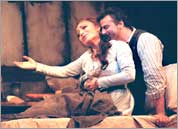
「あの3ディメンジョン版のラテン街をもう一度」
メトロポリタン歌劇場「ボエーム」
アラン・コージン 2000年10月31日(石綿さん訳)
好むと好まないにかかわらず、ゼフェレッリが1981年にメットに登場させた「ボエーム」のプロダクションの
凝りに凝った舞台装置には誰もが少なくとも一瞬は驚かざるをえない。
それがこの土曜日のシーズン初演に戻ってきたのである。
最初のシーンだけでゼフェレッリのねらいが明らかになる。風雪に耐えてきたパリの屋根、スレート色の空に
まがった煙突から煙を出しているのが見える、散らかった屋根裏部屋。ゼフェレッリのメットでの他の舞台同様、
金に糸目をつけずにやればオペラの舞台演出でも映画作りみたいになってしまうということだ。 おそらく
彼の舞台を評価するためにはこれを現在一般的な意味でのオペラだとは考えてはいけないのでないだろう −
つまり作品を洞察する新鮮な感覚も何度も同じ演出が繰り返されるうちにぼやけてくるということ − むしろ
3ディメンジョンの映画と考えるべきなのかもしれない。同じ脚本に基づいて俳優だけが替わる映画。
観客はいすにふんぞり返ってみているだけでいい。そうすればプッチーニのオペラが目の前に現れる。
ちょうどあの「カサブランカ」をビデオで見るようなものだ。ときにはリックをハンフリー・ボガードではなく
ヒュー・グラントが代わりに演じるかもしれない。
今回の配役にはメットは役柄にふさわしいよりすぐりの若い歌手たちを集めた。魅力的な声を持って
堂々とメットに登場した歌手たちだ。マルチェロ・ジョルダーニ、シシリア出身のテノールで、ここ数シーズン
メットに何回も登場している。 そしてチリ出身のクリスチナ・ガラルド−ドマス。
二人はロドルフォとミミに望まれるすべてのものそのものだ。ほっそりとして若々しく、舞台上を身軽に動く。
ともに主役二人のキャラクタにふさわしい声と力を持っている。
ジョルダーニが声量いっぱいに歌うとき、プラチド・ドミンゴの声質と歌唱スタイルを思わせる。しかし
ソットヴォーチェではよりさわやかでやわらかい響きを聞かせる。たとえば「冷たい手を」の最後のフレーズでは
それはみごとな効果をあげている。
ガラルドドマスはそれに劣らない出来栄えで情熱的また幾分エキゾチックなミミだ。声は芯がとおって
いながらかろやかで十分に力強い。この土曜日の公演でもっとも際立った彼女の特質はミミの素朴さと
心の暖かさを適度にコントロールしながらもダイナミックに表現した点であろう。ソンドラ・ラドバノフスキーは
持ち前の明るい声とイキのよさでムゼッタを演じた。
メット初出演のジャンリュック・シャイノーは思いやり深いマルチェロを好演。そして他のボヘミアンたち −
コリーネのリチャード・バーンスタイン、ショナールのマーク・オズワルドは −ベノアとアルチンドロの二役を
演じたトーマス・ハモンズ同様手堅いできばえであった。
舞台演出を引き継いだシャロン・トーマスは舞台上での人物の動きをより適切なものにしているし、
指揮のマルコ・アルミリアートはオーケストラの力強く説得力のある響きを十分に引き出している。
Welcome Back to the Latin Quarter (In 3-D)
Metropolitan Opera: "La Boheme"
ALLAN KOZINN
10/31/00
Like it or hate it, it is impossible not to marvel, at least for a moment, at the obsessive detail of the production of "La Boheme" that Franco Zeffirelli mounted at the Metropolitan Opera in 1981, and which returned for the first showing of the season on Saturday evening. The very first stage picture makes Mr. Zeffirelli's aims clear enough: the bohemians' cluttered garret sits on a line of weathered Parisian rooftops, many of them with bent chimneys pouring smoke into a slate sky.
|
|
|
|
| Cristina Gallardo-Domas and Marcello Giordani in "La Boheme," at the Met. (Sara Krulwich/The New York Times) | |
|
|
It shows, as do Mr. Zeffirelli's other Met stagings, that with a big enough budget, theatrical production can become cinematography. Perhaps the best way to regard these stagings is not as opera productions in the most modern sense - that is, productions in which a director seeks fresh insights within works that have become blunted by constant repetition - but as 3-D movies. Better still, think of them as 3-D movie sets with static scripts and regularly rotating casts. You can sit back and let Puccini's opera roll over you as if it were a videocassette of "Casablanca" in which some nights Rick is played by, say, Hugh Grant rather than Humphrey Bogart.
For its current cast, the Met has assembled a cast of young singers who are at ease in their roles and have both attractive voices and the power to project into the house. Marcello Giordani, a tenor from Sicily who has been heard a good deal at the Met in recent seasons, and Cristina Gallardo-Domas, a soprano from Chile, are virtually everything one wants in Rodolfo and Mim・ They are trim and youthful, they move well onstage, and they have both the timbre and the power to project their characterizations.
When Mr. Giordani sings at full volume, one hears an echo of Placido Domingo's timbre and style; but when he takes down the volume, he produces a drier, more soft-edged sound that he used to fine effect in, for example, the final phrases of "Che gelida manina."
Ms. Gallardo-Domas was an equally effective and affecting, if also slightly exotic, Mimi. Her sound is focused and light, but fully supported. Perhaps the most salient feature of her work on Saturday was the degree to which she used nicely controlled, expressive dynamics to convey a sense of Mimi's simplicity and warmth. Sondra Radvanovsky put her brighter timbre and high energy to good use as Musetta.
Jean-Luc Chaignaud made his house debut as
a sympathetic Marcello, and the other bohemians
- Richard Bernstein
as Colline and Mark Oswald as Schaunard -
as well as Thomas Hammons as Benoit and Alcindoro,
all contributed solidly. Sharon Thomas, who
has taken over the stage direction, moves
the action along efficiently, and Marco Armiliato
drew an appealingly robust sound from the
orchestra.