
「メットのピンチに救い主」
メトロポリタン歌劇場「バラの騎士」
2000年11月18日
アンソニー・トマシーニ(石綿さん訳)
ブルガリアのメゾソプラノ、ベッセリア・カサロバはどうもメトロポリタン歌劇場とは縁がないのか、不運がつきまとうようだ。
2年前期待の新鋭カサロバは「セビリアの理髪師」のロジーナ役でメットデビューの予定であったが病気のため辞退。
そして待ち焦がれた彼女のメットデビュー。ナザニエル・メリルの1969年版のあのリアルな演出によるリヒャルト・
シュトラウスの「バラの騎士」、シーズン初演のオクタビアン役でこの木曜日にいよいよ登場・・・・。
ところがまたしても3週間前、病気を理由に彼女は予定されていたオクタビアン役の出演を7回全部キャンセルした。
その理由は他にもあるというのが明らかだろう。
オクタビアンはメゾソプラノとしての真価が問われるドイツものの大役であり、彼女にとって初めての出演であった。
もともとベルカントオペラで評価が高い彼女ではあったが、この役は声楽的に一段の飛躍が必要なので、まだ少し
荷が重いということであろう。
とにかく、来月この「バラの騎士」の最後の公演で出演予定であったアメリカの若きメゾソプラノ、クリスティーネ・
ジェプソンがピンチヒッター。声の面でも演技の面でも達者なところを見せた。彼女の声はやや暗めだが豊かで
ホールいっぱいによく響く。しなやかな長身で全く舞台なれしている。伯爵の権威にあやかろうとしている大柄な若者、
あるいはまだほんの子供なのだが年上で世慣れたウェルデンベルグ元帥婦人を痛々しいほどに崇拝している、
もしくはそう信じ込んでおりながら、ゾフィーを一目見るやその若さあふれる魅力のとりことなってしまう青年、
そういう若者のぎこちなさを魅力的に演じている。
(ジェプソンはこのあとの公演ではこの役をスザンヌ・メンツァーとダブルキャストの予定)
マルシャリンこと元帥婦人役のチェリル・ステューダーの登場はより以上に期待を抱かせていた。
ステューダーはアメリカの偉大な歌手だが、ここ9年間は空白期間であった。
感動的なほど率直にインタービューに答えた彼女は声の障害があったことを明らかにした。
そのため数多くのファンが彼女を応援している。
声の障害は完治したといいたいところだが、今回の場合彼女の歌は感動的な箇所はあったがムラがあった。
大柄で肉付きがよく堂々としていながら感情的には繊細なマルシャリンだ。昨シーズンの内面的な心の動きを
クールに表現したルネ・フレミングと比べると傷つきやすい女心をより表に出した役作りである。
声楽的には豊かで輝くような声、しなやかな歌いまわしと深い表現力が散見されたが、概してその声にはムラがあった。
とくに中音から高音へ移るパッセージにはほころびが見える。この曲の最も魅力的な箇所のいくつかの場面で高音を
ピアノッシモで保持することがうまくできなかった。ナーバスになりすぎていたのかもしれないが、わからないでもない。
第3幕になってかなり安定してきた。この後の公演ではもっとよくなっていると思われる。
ソプラノのエリザベス・ノルベルグ・シュルツは明るく軽やかな声ではつらつとしたゾフィーを演じた。しかし時折息遣いが乱れるところがある。「銀のバラの献呈」場面では「天国のような」という言葉
で輝かしい高いハ音に向けて盛り上がっていくところでなぜ大きな息継ぎがでてくるのか。
オックス男爵を歌ったバスのエリック・ハーフバーソンは力強い低音とコミカルで芸達者な演技で見事に成功。
現在ベルリンドイツオペラの指揮者であるチェコ出身のジリ・コウトは軽快で快適な演奏である。
シュトラウスがあふれんばかりに書き込んだ叙情性もあっさり流し、過度にセンチメンタルにならないようにしていた。
オーケストラはコウトの楽曲の解釈についてまだよくなじんでおらず調整中という感じの演奏を聞かせたためか、
コウト自身は指揮台上で落ち着かない様子であった。
コウトは一応シュトラウスが意図していた憂いに満ちた喜歌劇をもっともらしく作り上げている。
Pinch Hitter Comes to the Rescue at the Met
Metropolitan Opera: "Der Rosenkavalier"
ANTHONY TOMMASINI
11/18/00
Is the karma just not right between the Bulgarian mezzo-soprano Vesselina Kasarova and the Metropolitan Opera? Two seasons ago, Ms. Kasarova, a major new artist, was scheduled to make her Met debut as Rosina in "The Barber of Seville." She withdrew because of illness. Her long-awaited debut was to have come on Thursday as Octavian in this season's first presentation of Strauss's "Rosenkavalier" in the realistic 1969 production by Nathaniel Merrill. But three weeks ago Ms. Kasarova withdrew from all seven of her scheduled Octavians, again citing illness. It's hard not to see other factors at play. These were to be her first performances of this touchstone German role, which is a vocal leap from the bel canto fare with which she has mostly earned her reputation.
|
|
|
|
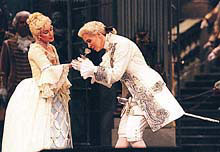
| Elizabeth Norberg-Schulz as Sophie and Kristine
Jepson as Octavian. (Sara Krulwich/The New
York Times) |
|
|
|
In any event, the young American mezzo-soprano Kristine Jepson, who was scheduled to sing in the last performance of "Der Rosenkavalier" next month, came to the rescue, delivering a vocally and dramatically assured performance. Her voice has a rich, dusky sound and carries well in the house. Tall, limber and completely at ease onstage, Ms. Jepson charmingly projected the awkwardness of a strapping adolescent male trying to muster the authority of a count, a mere boy who abjectly adores the older, worldly Princess von Werdenberg, or so he thinks, until he is vanquished at sight by fresh-faced young Sophie. (Ms. Jepson will share the role for the remaining performances at the Met with Susanne Mentzer.)
There was much anticipation over the appearance of the soprano Cheryl Studer as the Princess, known as the Marschallin. Ms. Studer, a greatly admired American artist, was returning to the Met after an absence of nine years and a period of vocal trouble that she has been touchingly candid about in recent interviews. So her many fans were rooting for her.
It would be good to report that the problems are gone, but on this occasion her singing, though affecting, was uneven. A buxom and naturally hardy actress, Ms. Studer was a matronly yet emotionally fragile Marschallin. Compared with the cooler though no less sympathetic approach to the role that Rene Fleming took last season, Ms. Studer's Marschallin was a vulnerable woman whose insecurities are close to the surface.
Vocally, she sang at times with rich, shimmering sound, supple phrasing and piercing insight into the text. But her voice was patchy, especially in the so-called passaggio, the exposed transition point between the middle and upper registers. She had some trouble sustaining soft high notes in a couple of the score's most magical moments. She may have been nervous, understandably, and her singing gained security in the third act. She may grow stronger still in later performances.
The soprano Elizabeth Norberg-Schulz brought her perky personality and bright, light soprano voice to the role of Sophie. Some of her phrasing, though, was curiously choppy. In the "Presentation of the Rose" scene, why take a big breath after the upbeat note leading to the glorious high A on the words "Wie himmlische?" With his robust bass voice and savvy comic acting skills, the bass Eric Halfvarson was a winning Baron Ochs.
Jiri Kout, a Czech conductor currently with the Deutsche Opera Berlin, led a fleet and buoyant performance. There was no dawdling in the sumptuously lyrical spans of the score, lest it turn sentimental. Mr. Kout has a fidgety manner on the podium that may take adjusting to, and the Met musicians sounded as if they were still accustoming themselves to his conception of the score. The playing was not always together. But Mr. Kout had "Der Rosenkavalier" seeming like the wistfully comic opera Strauss intended it to be.