An Old 'Trovatore' Gets a Tuneup
Graham Vick's New Production of "Il
Trovatore" at the Met
ANTHONY TOMMASINI
12/09/00
When it comes to staging the bread-and-butter
operas it must depend on, the Metropolitan
Opera has been loath to take risks with untraditional
new productions. So the company at least
deserves credit for entrusting Verdi's eternally
popular but problematic "Il Trovatore"
to the bold British director Graham Vick.
 |
|
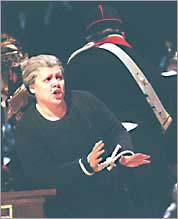 |
The mezzo-soprano Dolora Zajick as Azucena
in the Met's production of "Il Trovatore."
(Sara Krulwich/The New York Times)
|
|
Having proved himself with inspired and daring
recent productions of two gnarly 20th-century
masterpieces, Shostakovich's "Lady Macbeth
of Mtsensk" and Schoenberg's "Moses
und Aron," Mr. Vick made clear beforehand
that he wanted to take a radically different
approach to "Il Trovatore."
Unfortunately, Mr. Vick's production,
given
its premiere on Thursday night,
is a hapless
muddle and a major disappointment
of this
Verdi anniversary season. When
Mr. Vick and
the lighting designer Matthew
Richardson
took the stage for curtain calls,
they were
roundly booed. The costume and
set designer,
Paul Brown, did not appear.
Certainly, Fabrizio Melano's 1987 Met production,
in which the stage was dominated by monumental
movable columns, had employed the traditional
approach and failed. The time had come, it
seemed, to reclaim "Il Trovatore,"
a famously easy target of parody, as a great,
grim and deeply humane work of musical drama.
Mr. Vick's production is full of ideas. Too
many ideas. And even the potentially effective
ideas were ineptly executed during this shaky
opening performance. An honorable cast gamely
tried to make something happen. But with
the exception of the mezzo-soprano Dolora
Zajick as Azucena, the singers looked painfully
uncomfortable.
What went wrong? Mr. Vick rightly believes
that the convoluted plot turns of "Il
Trovatore" should not be seen as flaws.
For Verdi, the libretto, however contrived,
was a streamlined vehicle rich with situations
that he could seize on to depict with his
uncanny psychological insight into characters
in the throes of archetypal human conflicts.
Trying to similarly focus attention on those
situations and characters, Mr. Vick jettisoned
the story's setting of 15th-century Spain.
The opera is a 19th-century Italian melodrama,
and Mr. Vick and his creative team have tried
to evoke that period in the direction and
visual concept.
The backdrop of "Il Trovatore"
is the civil war that has been raging between
the House of Aragon, whose troops are commanded
by the Count de Luna, and the rebels pledged
to Prince Urgel, led by Manrico, the brooding
son, or so he thinks, of the Gypsy woman,
Azucena. Though they do not know it, the
Count and Manrico are brothers. Azucena knows
the truth, and it is killing her. Long ago
she stole the infant Manrico from the man
who murdered her mother. Verdi, who made
enemies easily, was excited by the idea of
political and romantic rivals who are drawn
together by a primal connection they don't
understand.
But Mr. Vick's production is at cross-purposes
with itself. The touches of Italian melodrama
do not work well with the stark, modern abstract
look of the set: two huge movable, intersecting
walls, one charcoal gray the other creamy
white.
And the costumes are highly stylized to no
discernible effect. Manrico, portrayed by
the tenor Neil Shicoff, and the Count, the
baritone Roberto Frontali, are meant to look
eerily alike: uniformed and trim men with
pasty-white facial makeup and matching black
beards and mustaches. They wind up seeming
spectral and insignificant, like mere props
in the director's show. And the count's troops,
who also wear pasty makeup, look like Keystone
Kops in soldiers' costumes with gold epaulets,
crimson sashes and funny hats.
In a good production, Leonora, the lady-in-waiting
to the Princess of Aragon, is much more than
a generically noble Verdi heroine. Though
pursued by the willful Count, she loves Manrico,
an impassioned stranger from a lower class,
the troubadour of the opera's title. But
here Leonora, portrayed by the Russian soprano
Marina Mescheriakova, must wear a low-cut
gown with an enormous puffy skirt. She looks
like a parody of Scarlett O'Hara at a ball.
What's the point? That Leonora is ensnared
in her social station? If so, is making that
point worth encumbering a soprano with a
demeaning costume?
You had to feel sorry for Mr. Shicoff, who,
it was announced, was singing despite his
lingering flu. Surely it was not his cold,
but the travails he was subjected to that
caused his visible distress. In Act II, the
libretto says, Manrico appears as if from
heaven at the chapel where Leonora, thinking
him dead, is about to take the veil. Mr.
Vick treats this image literally: Mr. Shicoff
had to walk down a ramp in the shape of a
cross that fell from the gray wall of the
set with a thud on the altar. As he tenuously
trod the plank, the audience just laughed.
Later on he had to sing "Di Quella Pira,"
the most spectacular tenor cabaletta in opera,
while balancing himself on a seesawing white
staircase. This time the audience felt too
badly for him to laugh.
The poignant final scene when Manrico and
Azucena are in prison awaiting execution
is played atop a rippled floor meant to look
like a slab of the white wall that has collapsed
and buckled. Why? All you could do is worry
that the singers would slip and fall. This
is the kind of set piece that may have looked
powerfully abstract as a mockup model. But
the rickety reality was absurd.
Perhaps discomfort with the production accounted
for the tentative musical performance, but
the conductor Carlo Rizzi must be mostly
held responsible. Even simple matters of
coordination between the singers and the
orchestra were off. The chorus sounded surprisingly
feeble.
Mr. Shicoff valiantly persevered and did
some impressive singing. When his throat
clears up he should sound splendid. Ms. Mescheriakova's
voice was curiously uneven, sometimes rich,
vibrant and attractive, at other times marred
by weak low tones, pinched high notes and
a tendency to veer sharp in pitch. Mr. Frontali
gave an ardent, stylish and solid performance.
Ms. Zajick's powerhouse voice and stage presence
has never seemed more welcome. At least she
had a decent costume, a plain black dress
and gray wig. She looked like a long- suffering
Italian widow, and she dominated every scene
she was in. It was as if she had decided
that whatever else was going on around her
she was going to sings Verdi's music with
all her soul and be Azucena.
Who would ever have thought that lovers of
"Il Trovatore" would actually miss
those clunky black movable columns from the
unimaginatively traditional old Met production?
IL TROVATORE
Opera in four acts by Giuseppe Verdi, libretto
by Salvadore Cammarano, from Antonio Garcú}
Gutiérrez's drama "El Trovador";
conductor, Carlo Rizzi; production by Graham
Vick; sets and costumes by Paul Brown; lighting
by Matthew Richardson. At the Metropolitan
Opera.
WITH: Marina Mescheriakova (Leonora), Dolora
Zajick (Azucena), Neil Shicoff (Manrico),
Roberto Frontali (Count de Luna), Dimitri
Kavrakos (Ferrando), Jane Shaulis (Inez),
Ronald Naldi (Ruiz), John Shelhart (Gypsy)
and David Lowe (Messenger).
|