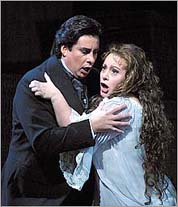
| A Soprano Put to the Test Shifts in Tone
and Intensity "La Traviata" at the Metropolitan Opera ANTHONY TOMMASINI 12/14/00 For an opera singer, the 20's and even the early 30's can be years of vocal growth. But by the early 40's the natural changes in the colorings and weight of the voice are usually finished and a singer's artistry is matured.
For years Ms. Swenson was admired as an exquisite coloratura soprano with a clear, perfectly focused voice and impressive technical agility, ideally suited to the bel canto repertory. Some critics felt that her singing lacked spontaneity and temperament. But for sheer vocal beauty she was hard to top. In recent years Ms. Swenson has been taking on roles that require more vocal weight, like LiEin Puccini's "Turandot." Violetta represents another step in that direction. This role famously demands different vocal qualities in different acts. In Act I, as Violetta plays host to a gathering of fashionable Parisian friends who are not shocked by her status as the courtesan of a wealthy baron, she expresses her life credo of coveting freedom and resisting ties through ebullient music rich with fancy coloratura roulades and filigree. But in the later acts, as she sacrifices her smitten lover Alfredo to placate his upright father, Germont, and then faces despair, abandonment and death, a soprano must bring true spinto resonance and body to her singing. You would have expected Ms. Swenson to excel in Act I. But, judged against her own high standard, she seemed somewhat tentative in her execution of the coloratura passage work. Ms. Swenson is known to get the jitters on opening nights. But perhaps what was going on is that her voice is shifting downward in placement and gaining substance. Sure enough, as the evening progressed, Ms. Swenson's performance grew more assured. She was quite moving in "Addio del passato," Violetta's wrenching farewell to life itself, sung with floating tone and supple phrasing. And though she may be too hearty for an ideal Violetta, Ms. Swenson brought a dramatic intensity to her portrayal that also presaged a new dimension of her artistry. Her Alfredo was the Argentine tenor Marcelo Álvarez. Many struggling singers would envy the way Mr. Álvarez has been promoted. But the campaign has built up expectations that the tenor has been unable to fulfill in person. He has a basically warm and appealing voice and a husky, handsome stage presence. But his voice is not exceptional or especially charismatic. And he still seems to be acquiring style and technique. It was announced beforehand that although the baritone Dwayne Croft, who was singing his first Germont at the house, was fighting a cold, he would still perform. Except for some slight signs of congestion, his singing seemed typically robust. He brought arching lyricism and great dignity to his portrayal of the well-meaning but misguided father. The young German conductor Jun Märkl, though overly free in some moments of expressive ritardando, led a well-paced and lithe performance. Mr. Zeffirelli's 1998 production is either sumptuously grand or gaudily excessive, depending upon your taste. The Met has at least cleared out some of the clutter in the big party scene. The dancing cows are gone. Or, this time out, did the women dancers just refuse to don those demeaning costumes with the cow heads and extra padding in the posteriors? |
|||||||