'Aida' at the Metropolitan Opera
JAMES R. OESTREICH
10/11/99
Although any number of productions, mostly by Franco Zeffirelli, have shown that it is possible to fill the vast stage of the Metropolitan Opera House if cost is no object, few have taken the additional step of seeming to overwhelm that space. Sonja Frisell's production of Verdi's "Aida," which returned to the Met on Friday evening, is one that does, and remarkably, this was the production substituted in 1988 for a planned Zeffirelli staging that promised to run too rich even for the Met's blood.
 |
 |
|
|
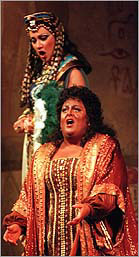
| Deborah Voigt, front, as Aida and Olga Borodia as Amneris. (Sara Krulwich/The New York Times) | |
|
With monumental sets designed by Gianni Quaranta accommodating merely the legs of huge statues that must be presumed to rise into the skies, Ms. Frisell plays up the stately grandeur against which the love triangle of two Egyptian worthies, the warrior Radames and the King's daughter, Amneris, and the Ethiopian slave Aida plays out. But despite throngs of spear carriers, onstage musicians and even horses, these inflated precincts have often seemed rattlingly empty because of glaring weaknesses in the central roles. Not so here, at least among the women.
Amneris, in fact, has often been served well in this era rich in mezzo-sopranos, typically with little competition from the Aida, and Olga Borodina may be the most captivating Amneris yet in this production. She sings the role with utter security, as convincing in her overtures to Radames, spurned though they may be, as in her subsequent rages. Carrying herself with regal presence, she develops a character who could stand up to any Aida and upstage most.
Then again, Deborah Voigt is not most. Ms. Voigt, who has emerged as a rising star in German repertory, especially the operas of Richard Strauss, here makes a major claim for herself as a Verdi soprano.
She seemed tentative at first, an impression fostered by her unprepossessing appearance, resulting in part from a silly-looking, perhaps ill-fitting black wig. But as the evening progressed, particularly with "O patria mia" in the third act, it appeared that Ms. Voigt had simply been pacing herself cannily. An act later, she was still singing with free, full, lovely tone. Her little cascading descent from her final high note was as melting as one could want.
Fabio Armiliato's Radames was an altogether sadder story. Although Mr. Armiliato could produce clarion sounds to rival the onstage trumpets, he often got to those tones by way of ungainly heaves and swoops and had a hard time sustaining them without spinning sharp. Yet by the end of a strained evening, he tended everywhere toward flatness.
Nikolai Putilin was strong yet affecting as Amonasro. Peter Rose, as Ramfis, and Dean Peterson, as the King of Egypt, sang with solidity if little color.
With Carlo Rizzi conducting, the orchestra had not yet come into focus, and coordination with the stage was occasionally tenuous. Those matters, like the accident-prone lighting, will undoubtedly be ironed out in future performances, beginning this evening. When they are, this may be as persuasive an outing as Ms. Frisell's production has had.