Married, With Arias: Romance Onstage, Too
'L'Elisir d'Amore' at the Metropolitan Opera
ALLAN KOZINN
12/02/99
The Metropolitan Opera brought back its storybook production of Donizetti's "Elisir d'Amore" on Tuesday evening, but more to the point, the company brought back the tenor Roberto Alagna and the soprano Angela Gheorghiu, who are married to each other, to sing the romantic leads.
 |
 |
|
|
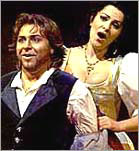
| Roberto Alagna and Angela Gheorghiu during a rehearsal for "Elisir d'Amore." (Keith Meyers/The New York Times) | |
|
Mr. Alagna and Ms. Gheorghiu are young and trim, and have voices that are suited to these roles, indeed, to many another pairing in the great canon of operatic lovers. In theory, na・e as it may seem, their policy of always working together should guarantee the kind of chemistry that was evident on Tuesday.
They have quickly discovered, though, that it is no longer the 1950's. Or at least that they are in no position this early in their careers to make the kinds of demands or unleash the displays of temperament that were the calling cards of divas past. When they insisted on the right to approve the stage designs for a production of "La Traviata" a few seasons ago, the Met rebuffed them. When their countermove was to hesitate before signing the contract, the Met withdrew it.
It was the kind of unambiguous power play the opera world loves to chatter about in the absence of anything truly compelling on the stage. Still, given the couple's popularity and the likelihood that it will grow, sending them into permanent exile would not have been good business. So it was only a matter of days before the Met offered them this "Elisir."
Since they already knew this 1991 John Copley production, with its pastel-hued sets and bright costumes by Beni Montresor ? Mr. Alagna appeared as its Nemorino in 1996 ? the offer circumvented their need to approve stage designs. The official word is that they were on their best behavior during the rehearsals. They bring an important measure of individuality to their portrayals. The Met's first-string Nemorino in recent seasons has been Luciano Pavarotti, who has played the character as a lovable oaf who gets the girl by dint of his innocence. Mr. Alagna's version is nuanced differently: he plays up the desperation of his love for Adina more melodramatically and borrows a strand of Papageno's DNA to create the endearing empty-headedness that makes Nemorino so vulnerable to Dulcamara's hucksterish wiles.
There is also, of course, the matter of a firm, attractive timbre and a sense of how to wow an audience by lingering on beautifully produced notes (not necessarily the high ones) and moving expertly through the ornaments in Donizetti's later, more florid version of "Una furtiva lagrima."
Ms. Gheorghiu's Adina, similarly, departed from the more self-consciously cute and coy portrayals that Kathleen Battle and Ruth Swenson have made the house norm. Ms. Gheorghiu's characterization is more steely at first, and not only because her stage laugh evokes Margaret Hamilton's as the Wicked Witch in "The Wizard of Oz." She takes her time showing Adina's softer side, and that works well with Mr. Alagna's studiously innocent portrayal of her rustic suitor. Vocally, too, she is Mr. Alagna's match: her singing had an appealing fluidity, ample variety and an admirable consistency from top to bottom.
The production also benefits from Dmitri Hvorostovsky's uncharacteristically lightweight portrayal of Belcore, and Paul Plishka's masterly Dulcamara. And Evelino Pido who conducted this couple's recording of "Elisir" on EMI Classics and was making his house debut, drew a finely blended, bright sound from the orchestra.