'Giulio Cesare' at the Metropolitan Opera
PAUL GRIFFITHS
05/03/00
Opera is many other things besides, but it can also be a parade of gorgeous voices, one after another, in thrilling and touching songs. Handel's "Giulio Cesare" returned to the Met on Friday with most of the same outstanding principals it had last season.
 |
 |
|
|
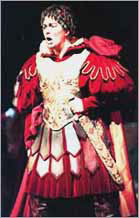
| Jennifer Larmore in the title role of Handel''s "Giulio Cesare." (Richard Termine for The New York Times) | |
|
In the title role, Jennifer Larmore stands on the ground as if she owns it and sings with the same command. Her tone is bright and eager, and her phrases leap into action. She is especially good in Caesar's martial numbers: she seems to enjoy the scent of musical battle and the chance to engage vividly and vigorously with the orchestra. She also has fun with the cross-dressing. Though she looks good as a man, her voice is richly and gloriously female, and in playing the world conqueror she is humorously aware of the deception she is imposing. One hears the smile behind the mask.
Handel's two contrasted heroines, the noble and the naughty, are presented by Stephanie Blythe and Hei-Kyung Hong. Ms. Blythe, as Cornelia, is magnificent. In everything she does, she combines poignancy with stateliness, true in that to the aesthetics of the Baroque. Also very much in style is her use of vibrato as an expressive device. She thereby brings forward a remarkable range of vocal colors, from the stony to the feather light or creamy, all apt to the meaning of the moment and smoothly worked into the phrase. Hers is a resourceful and even daring performance, too, in how she allows her voice to fall to the level of the instruments at times, or to bloom slowly out from instrumental tone.
Ms. Hong is a brilliant performer, and in this she is the image of her character, Cleopatra. Her voice shines, and her projection is unerring, as is her agility. Though she sings marvelously in one of the great Baroque laments, "Piangero," from a quiet center and with beautiful ornaments falling into the repeat section like slow tears, one is never quite sure of her emotional truthfulness. And this is right: after all, Cleopatra spends most of the opera using the guiles of love to further her familial-political intrigue, and at the end, just as one begins to think she might really be in love with Caesar, cheerfully exchanges his heart for his hand in helping her onto the throne. Ms. Hong excellently conveys the character's sense of singing as power, and in her fast arias her decorations are as exact, dazzling and effective as the rhinestones on her several tiaras.
There is a nice and useful difference, too, between the countertenors, David Daniels and Brian Asawa. Mr. Daniels, as Sextus, is characteristically and exquisitely sweet and yet also completely fresh, as if singing this way were the most natural thing in the world. Generally he comes to the same position for each of his arias, center stage left, and just sings. This is all he has to do.
In a similar way, he maintains the same vocal character−− honeyed, sensual −− within which he can run the gamut from mourning to protest. It is quite an achievement to present a character for whom sex is not an issue, to do so frankly and believably, and yet all the time to be singing so seductively.
Mr. Asawa accomplishes a difficult task, too, in singing and acting the weakling schemer, Ptolemy. He uses the coolness and artificiality of falsetto to convey the character's decadence and nastiness, but at the same time his singing is immediate, forceful and alert. He also moves well and uses a series of extravagant costumes to his advantage at every turn.
Among all these high fliers, Julien Robbins has the bass role of Achillas, in which he is appropriately soft and strong. With his height and by his singing, he suggests a big, simple soul misled by love.
John Nelson conducts an able, straightforward orchestral performance, with luscious plucked strings in much of the slow music, capable obbligato soloists and some electric uptempo movements. The remaining performances will be tonight and Saturday afternoon.