
Soprano Dons the Wagnerian Crown in a Musical Coronation
'Gotterdammerung' at the Metropolitan Opera
ANTHONY TOMMASINI
04/24/00
Singing at the Metropolitan Opera usually represents the biggest step in an artist's emergence. That step is not taken lightly. The Met plans its schedule years in advance, so it can take the company a while to catch up with a significant new singer.
 |
|
|
|
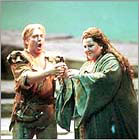
| Stig Andersen and Jane Eaglen are Siegfried and Brunnhilde. (Jack Vartoogian for The New York Times) | |
|
That certainly was true of the soprano Jane Eaglen. As Ms. Eaglen was increasingly acclaimed throughout the world during the mid-1990's as the most promising Wagnerian soprano to come along since Birgit Nilsson, her career at the Metropolitan Opera was minimal. Her almost unnoticed Met debut came in 1996 when she took over the role of Donna Anna in Mozart's "Don Giovanni." In the fall of 1997 she sang six performances of the title role of Puccini's "Turandot" with what was generally regarded as mixed success. Last season she did not appear with the company.
But this has been the season of Jane Eaglen at the Met. In the fall she gave critically hailed performances as Wagner's Isolde. And on Saturday, with the matinee performance of "Gotterdammerung," concluding the first of three complete presentations of Wagner's "Ring" cycle this spring, Ms. Eaglen has brought her Brunnhilde to the house. Now, having heard her in four major Wagner operas, grateful Met audiences have finally grasped the significance of Ms. Eaglen's artistry.
Her voice is not without faults. Her low range is weak and breathy. And her top notes are curiously inconsistent. She certainly does not fear the highs: in her gripping account of the immolation scene she leaped above the staff and filled the hall with sound. But sometimes the quality of her top notes was thin toned and devoid of vibrato, and her pitch tended to veer sharp.
Yet Brunnhilde's music is mostly concentrated in the middle and upper-middle vocal registers, and here Ms. Eaglen's soprano is wondrous. Her tone is plush, rich and poignant. And her sound is so naturally resonant that she can fill Wagner's vocal lines and soar over the orchestra without any sense of effort. She phrases with a quality of Italianate lyricism and, unlike most Wagner sopranos, executes the occasional trills that are in the score.
Ms. Eaglen has been criticized as a stolid singing actress, which, in part has to do with her considerable size. But in this regard she has improved in recent years. Her Met Brunnhildes were notably more musically incisive and dramatically convincing than her Brunnhildes for the San Francisco Opera's "Ring" just last summer. The difference may be due to James Levine. Once again the Met orchestra played magnificently for Mr. Levine. Ms. Eaglen seemed to respond well to his shaping of the score, by turns dynamic, supple and boldly spacious.
She also worked well with the Danish tenor Stig Andersen, who brought unflagging energy and alert musicianship to the role or Siegfried. During Act I, Mr. Andersen's voice sounded weaker and more throaty than it had the previous Saturday, when he made his Met debut in the title role of "Siegfried." Sure enough, before Act II it was announced that he had a bronchial infection, and that he asked for the audience's indulgence as he continued. By Act III he was coughing and clearly uncomfortable, but he sang ardently to the end.
Wagner fans are the most admirably attentive and enthusiastic of opera buffs. The booming bass Eric Halfvarson as the tormented Hagen and the robust baritone Alan Held as the weak-willed Gunther cannot often get the kind of thunderous ovations they received on this occasion. The rich-voiced mezzo-soprano Felicity Palmer was also cheered for her Met debut as Waltraute.
The soprano Sondra Radvanovsky brought a vulnerable quality to her portrayal of the insecure, needy Gutrune, though her voice was somewhat tremulous. The Rhine Maidens and the Three Norns were strongly cast, with Christine Goerke, as the Third Norn, especially splendid. When is the Met going to promote this excellent soprano who came from its own training program?
If judged on an applause meter, the biggest ovations of all may have gone to Mr. Levine and the orchestra. You will get no arguments from this listener about that.