When Life Was a Waltz, The Widow Was Merrier
'The Merry Widow' at the Metropolitan Opera
BERNARD HOLLAND
02/19/00
"The Merry Widow" does not come willingly into the 21st century, and the Metropolitan Opera has politely declined to prod it in our direction. Ninety-five years separate the house's new production from the Vienna original of 1905. Societies and cultures have come and gone since then, but the Met was in an archaeological mood on Thursday night, seemingly happy to leave Franz Lehar's beloved piece resting comfortably in the vanished world from which it came. The audience had no choice but to look back and hope for as unobstructed a view as possible.
 |
 |
|
|
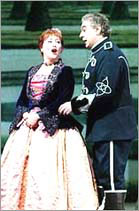
| Frederica von Stade and Placido Domingo in 'The Merry Widow.' (Sara Krulwich/The New York Times) | |
|
It was not an easy job but by no means a tortured one. The now and the then of "The Merry Widow" speak of new centuries turning at a very different rate. Lehar's comedic values are not our own; his silliness is not our silliness, and his naughty behavior rests at some distance from any current definition of bad. Tim Albery's modest production abjures connection-making. It sits there with its slightly simpering smile and hopes that the old jokes will at least get by.
A great body of opera does well under such circumstances. What brings Donizetti or Bellini forward in time is the power of their music, a medium less subject to changes in cultural landscape. "The Merry Widow" has at least three memorable tunes; and if Lehar was anything, he was a master of digestible charm. The famous waltz, for one, delights our ears and then floats out of earshot; it goes down the throat smoothly but doesn't leave much of a taste behind.
Missing is the profound originality of "Die Fledermaus," the clear-eyed pathos of Irving Berlin or the sardonic tone of Cole Porter. Music lovers today identify the year 1905 with Richard Strauss, Schoenberg, Debussy and an emerging new music. "The Merry Widow" was aimed at a pleasure-seeking audience whose pleasures are no longer ours.
An opulent and gimmick-filled production might have raised the attention span, but Antony McDonald's allusions to old cut-out and painted scenery speak more of prudence and economy. His bright costumes are much more appealing than what is around them.
This "Merry Widow" also tries to solicit our interest with racy and suggestive dancing in the final scenes. Apparently there to provoke as well is the lopsided decor and prominent wall cracks at the Pontevedrian embassy in Act I. Are they simply visual code for a small country's penury, or do they, along with the gratuitous appearance of streetwalkers at the opening curtain, hint at social commentary as well? Whatever the intentions, the bawdy and the seedy, I am afraid, faded into irrelevance, overpowered by the sweetness surrounding them.
Our story concerns the very rich Hanna Glawari and a fortune much needed by her destitute little country. We are taken through the various efforts to steer Hanna and her money to a Pontevedrian marriage and away from a French one. On the way, various infidelities are revealed and smiled at. Throw in a few misidentifications, marital anguishes and a happy ending and there we have "The Merry Widow."
Venerable and distinguished might be the best descriptions of Thursday's principals. Frederica von Stade filled the title role in perfectly acceptable fashion, smiling and flouncing effectively and singing with a full if not terribly well-lit mezzo-soprano. Her prime romantic interest is Placido Domingo, who sings well, enunciates in impenetrable English and tries not to look foolish cavorting on the dance floor or in high-kicking chorus lines.
As Baron Zeta, John Del Carlo towers physically over a cast not notable for shortness. His bass-baritone works very effectively and he wrestles as best he can with the stock physical comedy and tired punch lines that befall the part. Emily Pulley (Valencienne) and Paul Groves (Camille) are a strong pair of illicit lovers.
The reasons for this production remain a mystery, at least to me, but its strongest asset ? and the maker of its strongest arguments ? is the conductor, Andrew Davis. Sir Andrew's love of this piece was palpable at every moment, and his musical skill guided stage and pit in near-perfect harmony.