Fans Have A Singer To Argue About
'Rigoletto' at the Metropolitan Opera
ANTHONY TOMMASINI
12/27/99
Real opera fans relish nothing more than a nice contentious debate about a singer, and Paolo Gavanelli is going to provoke one for sure. This Italian baritone sang the title role in Verdi's "Rigoletto" at the Metropolitan Opera on Friday night, the first performance this season of the 1989 Otto Schenk production. By the first intermission audience members in the lobby were heatedly exchanging assessments of Mr. Gavanelli's singing.
 |
 |
|
|
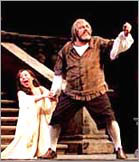
| Sumi Jo as Gilda and Paolo Gavanelli in the title role in "Rigoletto." (Sara Krulwich/The New York Times) | |
|
Since his Met debut in 1990 as Count di Luna in Verdi's "Trovatore," Mr. Gavanelli has sung periodically with the company, including some performances earlier this season as Alfio in "Cavalleria Rusticana." But Alfio is a relatively short role. No one can perform Rigoletto, a touchstone of the baritone repertory, without revealing the full range of his vocal and dramatic resources.
Mr. Gavanelli's singing is not conventionally beautiful. His tone is somewhat thin, and he uses vibrato sparingly. His voice is not especially large: he can summon robust sound in his chesty low range, but his top notes lack power. His middle-range lyrical singing is, depending on one's view, either the hallmark of his artistry or his major shortcoming.
He shapes Verdi's long-spun melodic lines with suppleness and poignancy, singing with focused tone, confident breath control and restrained emotionalism. Some opera buffs will consider this approach as true to the Italian operatic style that values melodic continuity and vocal evenness. Other vocal devotees will simply find his singing thin-toned, insufficiently supported and croony.
Those who can overlook his vocal idiosyncrasies and listen for style and interpretive richness will find things to admire in Mr. Gavanelli's work. He is also a vivid actor. As played here, this hunchbacked jester at the court of the rapacious Duke of Mantua commands the stage, entertaining the courtiers with his barbed jokes and mocking imitations of the Duke's wronged accusers. Conveying Rigoletto's bodily deformity, Mr. Gavanelli shuffles from side to side as he walks. At the palace he is light on his feet and full of swagger. But later on, alone, sunk by the reality that he must make a fool of himself to amuse men he despises, that same unsteady step turns heavy, halting and pathetic.
The Duke was sung by the tenor Marcelo Alvarez, who made his Met debut last season in the new production of Verdi's "Traviata," and Mr. Alvarez is also likely to divide opinion. He emerged from Argentina atop a wave of publicity promoting him as the dashing young tenor hope for the future. Though he is looking a little huskier these days, he certainly has a burnished, sizeable voice.
But on this occasion he seemed to cover over some vocal rough spots with tenorial bluster and emotive huffing. Perhaps because "La Donna e mobile" is such an iconic aria, he was wary of fussing around with it: this was his most straightforward and impressive singing of the night. But in general his blatant approach was in stark contrast to Mr. Gavanelli's subtlety.
The soprano Sumi Jo was excellent as Gilda, Rigoletto's tragically overprotected daughter. When she made her Met debut 10 years ago (in this role) Ms. Jo was already a technically exquisite and stylistically informed singer. Her artistry has only deepened over the years, and her voice today is more richly colored than ever. Ms. Jo's soft, sustained upper-range-lying singing was especially beautiful. Though not a highly skilled actress, she was always a winning stage presence.
The fine German bass Franz Hawlata was chillingly good as the hired assassin Sparafucile, and the mezzo-soprano Victoria Livengood was a naturally seductive and vocally alluring Maddalena, Sparafucile's sister and accomplice in crime.
It is too early to tell after just one performance, but Vladimir Jurowski, a 27-year-old Russian-born conductor who made his Met debut, could become valuable to the company. He has already conducted a wide range of repertory in opera houses around the world, and he brought a precise technique, abundant energy and excellent musical instincts to his work. The playing of the orchestra was crisp and resonant. He was admirably sensitive to the singers, allowing them plenty of breathing room without losing the thread of musical continuity. Mr. Gavanelli, who sings with great expressive freedom, was lucky to have Mr. Jurowski in the pit.