A Barber With His Altered Agenda
'Il Barbiere di Siviglia' at the Metropolitan Opera
ANTHONY TOMMASINI
03/15/00
Comic geniuses from Moliere to the Marx Brothers have understood that for a stage comedy to work, a performance must be fleet and precise but relaxed. There can be no sense of effort, no sense of practiced routine.
 |
 |
|
|
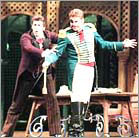
| Thomas Hampson, left, as Figaro and Michael Schade as Count Almaviva in "Il Barbiere di Siviglia." (Sara Krulwich/The New York Times) | |
|
That's a high standard to set in the opera house, where singers and conductors in lighthearted works have a lot more on their minds than comic timing and sight gags. The production of Rossini's "Barbiere di Siviglia" that opened on Monday night at the Metropolitan Opera is a case in point.
The performance, with the baritone Thomas Hampson in the title role, had many winning qualities. The 1982 production by John Cox is essentially charming, with its set by Robin Wagner that rotates to reveal interior and exterior views of Dr. Bartolo's house in Seville, Figaro's well-appointed barber shop and a tavern where sleepy Spaniards have their daily siesta. But there was a self-consciousness about the performance that made it seem not yet ready, not relaxed enough.
Mr. Hampson was a notable exception in this regard. Lately he has been moving steadily into the "tormented, full-bodied lyric repertoire" for operatic baritone, as he put it in a recent interview. Executing fleet Rossinian roulades is not as easy for him as it once was. But vocally he is wise to keep his bel canto roles active, and his robust sound and breezy charisma are ideal for Figaro. Relaxed, confident and light on his feet, Mr. Hampson's barber enjoys the ploy he and Count Almaviva (disguised as a poor student) plan against Dr. Bartolo, who keeps his pretty young ward Rosina under lock and key. And if the ploy fails, you can sense Figaro thinking, oh well, nothing is all that serious.
The veteran bass Paul Plishka, who replaced the indisposed John Del Carlo as Dr. Bartolo, was also excellent. His vibrato has acquired a bit of a wobble, but he still sings with commanding sound, great style and vitality. The tenor Michael Schade brought his sweet, lyric voice to the role of Almaviva. His execution of soft high-lying phrases was often beautiful: a true, carrying pianissimo, not a falsetto approximation. But Mr. Schade's coloratura runs were sometimes awkward, and in general his work lacked naturalness and grace. The Italian mezzo-soprano Sonia Ganassi, who made a fine Met debut as Rosina in 1997, returned to the role here but this time seemed less solid. Her light, lyric voice has a dusky mezzo coloration. And for a small woman, she is a plucky presence onstage. But her passage work was sometimes effortful. Egils Silins, a Latvian bass with an earthy deep-set voice, made his Met debut as Don Basilio, and nervousness may have accounted for his tentative performance.
The conductor Bruno Campanella, a Rossini specialist, led a supple and lithe account of the score. But the combination of exacting execution and easy relaxation that makes Rossini sparkle was not yet realized. Perhaps that will come in future performances.