
As the "Ring" Cycle Continues, a Test for a Tenor
ANTHONY TOMMASINI
04/17/00
Whenever an opera company decides to present a production of Wagner's four-part "Ring" cycle, the major stumbling block is always the same: who will sing the title role of the third opera, "Siegfried," the toughest dramatic tenor role in the entire repertory? Wagner admitted after the fact that he was so swept up with his vision for the "Ring" and his struggle to complete it that he lost sight of what was vocally possible.
 |
|
|
|
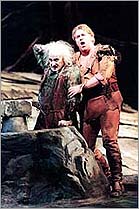
| Graham Clark, left, as Mime and Stig Andersen as Siegfried at the Met. (Sara Krulwich/The New York Times) | |
|
The opera has nearly four hours of music, and Siegfried sings during most of it. He must portray an impulsive and brawny youth. Yet it takes most tenors years to develop the vocal heft and stamina to handle the music.
Only one tenor in the 20th century sang it with the kind of heroic sound and command than Wagner envisioned: Lauritz Melchior.
On Saturday another Danish tenor, Stig Andersen, made his Metropolitan Opera debut in the title role of "Siegfried" in the first of the company's three complete "Ring" cycles this season. And if he is no threat to the Melchior legacy, Mr. Andersen is a creditable Siegfried, which is no small accomplishment.
He does not have a true heroic tenor voice like, say, Ben Heppner, a great Tristan who has avoided Siegfried, probably sensibly. Mr. Andersen's fine-grained sound, if not enormous, is robust and backed with solid technique. By skillfully pacing himself, he managed to summon enough power in the big moments to be heard over the thick orchestrations, though James Levine, an astute accompanist of singers as well as a great Wagner conductor, helped out by keeping the instrumental textures light and clear wherever possible.
Mr. Andersen started his career as a baritone, and his lower voice is still stronger than his top notes. Vocally this was a solid and intelligent account of the role, sung with rhythmic incisiveness and crisp diction.
Everything else about his portrayal was exceptional. He made this blockhead of a boy seem genuinely sympathetic. When he questioned Mime, the conniving dwarf who has reared him, about who his real parents were, this Siegfried seemed painfully vulnerable. With his reddish-blond hair, husky athletic build and youthful energy, Mr. Andersen looked great.
In a recent interview he was unwilling to reveal his age. But during intermission on Saturday, a friend of his, a Danish journalist, said he was 50. If so, that would mean this performance is probably the most complete account of the role he will give us. No backhanded compliment is intended by saying that Mr. Andersen is probably the best Siegfried we have right now.
The final cruelty that Wagner inflicted on Siegfried occurs in the last 30 minutes of the opera. He arrives on the fire-surrounded rock where Br・nhilde has been under a sleeping spell since "Die Walk・e." He wakes her, and they proceed into one of the most vocally taxing love scenes ever. He has been singing for hours; she is fresh as a daisy. As Br・nhilde, the soprano Jane Eaglen certainly sounded fresh, singing with her customary vocal plushness and presence. Mr. Levine seems to elicit the most dramatically involved work from this sometimes stolid singer.
The great bass James Morris was once again a vocally commanding and deeply affecting Wotan (here called the Wanderer), surely the great achievement of his career. The tenor Graham Clark gave a wily, spry and wonderfully nasal-toned portrayal of Mime. Singing Mime's bossy brother, Alberich, the baritone Ekkehard Wlaschiha offered bellowed growls and pitchless shouts in place of honest singing. The fine mezzo-soprano Birgitta Svenden sang Erda. The offstage voices of the bass Eric Halfvarson as Fafner the dragon and the soprano Heidi Grant Murphy as the Forest Bird were effective.
Ms. Eaglen and Mr. Andersen return on Saturday as the first cycle concludes with "Gotterdammerung." Here Wagner more evenly distributed the vocal demands on his ill-fated hero and heroine.