
ニューヨーク・タイムス・オペラ・レビュー
「トスカ」 1999年10月16日 アンソニー・トマシーニ(石綿さん訳)
苦しいけれどまだ出せる! パバロッティの最高音
フランコ・ゼフェレッリのよく知られている演出による「トスカ」がこの木曜日に夜、メットにかえってきた。しかし大勢の聴衆の関心はただ一つ。ほんの2日前だが、64歳になったルチアーノ・パバロッティに本当にカバラドッシが歌えるのかということ。
その答は条件付の「イエス」だ。 ただし、彼のパフォーマンスを斟酌しなければならないが。
第一に彼の健康の問題がある。昨年、彼はスタミナ不足と動きの悪さの元凶であった持病のひざと腰の痛みについて大手術を受けた。昨年11月の彼のメット出演30回目を記録するガラ・パーフォーマンスでは十分に回復しているところを見せたが、かろうじてというところで、まだまだ完全な回復ではなかった。彼の声は依然として際立った色艶と美しさを保っていたが、力強さに欠けていた。 その後、この春にはカバラドッシ役として文句無しのパフォーマンスをみせてカムバックした。
目下のところカバラドッシ役は今のパバロッティがこなせる数少ない役の一つのようだ。最後まで声をもたせるため大事に大事に声を節約しなければならないが、非常に印象に残る歌唱がいくつかあった。 それでもまだ、カバラドッシの役柄表現の上では十分なところまで至っていなかった。スカルピアの部下からむごい拷問を受けた後、マレンゴの戦でのナポレオンの勝利の声が聞こえると、カバラドッシは飛び上がって「勝利だ、勝利だ」と喜びの声をあげることになっている。
パバロッティはその個所をほとんどとってつけたように、舞台の端にゆっくりと進み聴衆に向かい合って仁王立ちし、気を鎮め、唇をなめて歌い始めた。 しかし、ともかく、初めは嬰へ音、それから嬰イ音の高音を、最強音でスリリングに鳴り響かせた。
それを歌い終わった後は、カバラドッシが感情を吐露して歌う残りの場面のために十分な声はもはや残っていなかった。パバロッティは概して低音が弱く途切れやすい。それでも、されどパバロッティだ。彼が引退したならさぞ、その声を惜しむことになるであろう。いくつかの問題はあってもパバロッティはこの夜の公演の中では最上であった。ソプラノ歌手エリザベス・ホリークはセクシーで情熱的なトスカを巧みに演じたが、悲しいことに彼女の声はこの役にはきつすぎたようだ。高音は息切れし、耳ざわりな叫び声となる。またフレージングは滑らかさに欠ける。スカルピア役のジュアン・ポンスは十分に力強い声だが、その代わり、ほとんどどの音にも息切れがみられた。 ダニエル・オーレンはスピーディでエネルギッシュな演奏であったが、時としてアンサンブルは乱れ、オーケストラの音色が重すぎた。
パバロッティは来シーズンまたカバラドッシで登場するだろうか。もしそうなら彼の忠実なファンはおおいに喝采を贈ることであろう。今シーズンは10月30日までの後4回の公演で彼が歌うことになっている。
Though Pressed, Pavarotti Still Hits the
High Notes
'Tosca' at the Metropolitan Opera
ANTHONY TOMMASINI
10/16/99
The popular Franco Zeffirelli production of Puccini's "Tosca" returned to the Metropolitan Opera on Thursday night, but the buzz in the house centered on one question only: could Luciano Pavarotti, just two days after his 64th birthday, still sing the role of Cavaradossi?
|
|
|
|
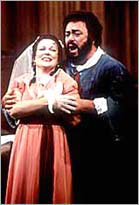
| Elizabeth Holleque in the title role and Luciano Pavarotti as Cavaradossi. (Winnie Klotz/Metropolitan Opera) | |
|
The answer is a qualified yes, though his performance has to be taken in context.
First is the matter of Mr. Pavarotti's health. Last year he underwent major knee and hip surgery correcting longstanding problems that had limited his mobility and stamina. He recovered sufficiently to sing the gala performance in late November marking his 30th season with the Met, but just barely. His voice still had its distinctive color and beauty, but lacked power. Then he returned in the spring for some quite satisfying performances as Cavaradossi.
By now this would appear to be one of the few roles he can still handle. Though he had to husband his vocal resources strategically to get through it, Mr. Pavarotti did some impressive singing. Yet here was not much in the way of character depiction. When Cavaradossi, after being brutally tortured by Scarpia's henchmen, overhears news of Napoleon's victory at the Battle of Marengo, he is supposed to leap to his feet and sing triumphant cries of "Vittoria! Vittoria!"
Mr. Pavarotti, hardly spontaneous, walked slowly to the rim of the stage, planted his feet firmly in place, faced the audience, composed himself, wet his lips and started to sing. But his full-voiced, ringing high notes ? first F sharp, then A sharp ? were thrillingly unleashed. Having delivered, he had scant voice left for the rest of Cavaradossi's outburst. Mr. Pavarotti generally sounded patchy and weak in his lower range. Still, there was that Pavarotti sound and we are going to miss it when he is gone.
Even with his shortcomings, Mr. Pavarotti gave the most complete performance of the evening. Dramatically, the soprano Elizabeth Holleque was an alluring and ardent Tosca. But her voice was sadly tested by this role. Her high notes were short-breathed, harsh and shouted. And there was little legato in her phrasing. As Scarpia, the baritone Juan Pons had ample power, but it came at a price: huffing and puffing behind nearly every note. Daniel Oren conducted a fleetly paced and vigorous performance, though sometimes the ensemble was inexact and the orchestral sound overly thick.
Will Mr. Pavarotti return next season for yet another try at Cavaradossi? If so, there will surely be loyal fans to cheer him on.
He sings four more performances, through
Oct. 30.
オペラ・レビューのページに戻る