Through Wagner, a Chance To Cherish Today's Masters
'Die Walkure' at the Metropolitan Opera
ANTHONY TOMMASINI
03/30/00
Unlike conductors and instrumentalists, who typically perform well into their golden years, singers understand that with maturity comes vocal decline. It must be terribly frustrating. No doubt Birgit Nilsson today has more insight than ever into the great roles she once sang, but long ago she had to bequeath them to a new generation of dramatic sopranos.
 |
 |
|
|
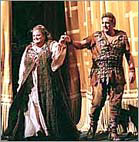
| Deborah Voigt and Placido Domingo taking curtain calls. (Richard Termine for The New York Times) | |
|
Perhaps the most illustrious of her successors right now is Jane Eaglen, who brought her portrayal of Brunnhilde in Wagner's "Walkure" to the Metropolitan Opera for the first time on Tuesday night. And Ms. Eaglen did not disappoint.
But it was the veterans in the cast who particularly moved me. And it is possible that two of them, the esteemed bass James Morris as Wotan and the inexhaustible tenor Placido Domingo as Siegmund, could be singing in their last complete "Ring" cycles at the Met.
Surely Mr. Morris realizes that at 53 his voice has lost some luster and smoothness, though he still can sing with chilling intensity and stentorian power. Yet perhaps because he cannot rely on his voice as readily as before, he is searching deeper than ever for subtlety and meaning. It will be a long time before a Wotan comes along who can convey the internal torment of this volatile, despairing and self-destructive god, who never, as Mr. Morris plays him, loses his stiff-backed, godly dignity.
Mr. Domingo is 59, but you would not know it from his urgent and impassioned Siegmund. He has been criticized often for giving perfunctory portrayals of the more than 100 roles he has taken on in his insanely busy career. Yet although 20 years ago no one could have predicted it, Siegmund is one of his great achievements.
A model of vocal health, Mr. Domingo knows how to sing without force, to cover his sound and ease into a phrase. But in moments of intensity he let his voice soar with thrilling, almost dangerous abandon.
The baritonal timbre of his sound is right for Siegmund, a strong, young but beaten-down outcast. And the Latinate lyricism Mr. Domingo brings to the role was refreshing. He delivered Siegmund's tender love ode to Sieglinde in Act I with affecting intimacy. For a moment, it might have been a Schumann lieder.
Sieglinde was the soprano Deborah Voigt, who is in her prime and just sings better and better. Her voice was radiant and richly colored. She and Mr. Domingo worked movingly together. When the glances of these strangers, who are actually twins separated at birth, met in Act I, the stage was charged with the power of their subliminal recognition.
Ms. Eaglen was, as expected, a vocally sumptuous Brunnhilde. She brings a quality of bel canto style to the role and even sings the high note trill in the "Hojotoho" greeting cry that most Brunnhildes ignore. Her top notes were sometimes a little edgy. But this was Wagner singing to cherish.
She is, of course, a woman of large proportions, and it would have been helpful if the stage director, Phebe Berkowitz, had better adapted the blocking in Otto Schenk's realistic 1896 production to Ms. Eaglen's limitations. It made one nervous to see her cautiously climbing up and down craggy rocks in the dark.
As Fricka, the mezzo-soprano Hanna Schwarz sang with more roughness than last week in "Das Rheingold" but brought searing intensity to her confrontation scene with her wayward husband, Wotan. The fine bass Eric Halfvarson was an imposing Hunding.
It is hard to keep finding new ways to describe how magnificently the Met Orchestra plays for Mr. Levine. This was a spacious and sonorous account of the score. For all the fire and turmoil of the music making, the subdued beauty of Mr. Levine's performance reminded you that mostly ruminative opera is sometimes likened to the slow second movement of a four-movement symphony.
"Die Walkure" will be repeated on Saturday afternoon in the first of the Met's three complete presentations of the "Ring" cycle. The next time the complete "Ring" comes to the Met, probably in three or four years, opera fans can reasonably assume that Mr. Levine will be on the podium. We cannot be so sure, however, about Mr. Domingo and Mr. Morris, which is why we should treasure them today.